
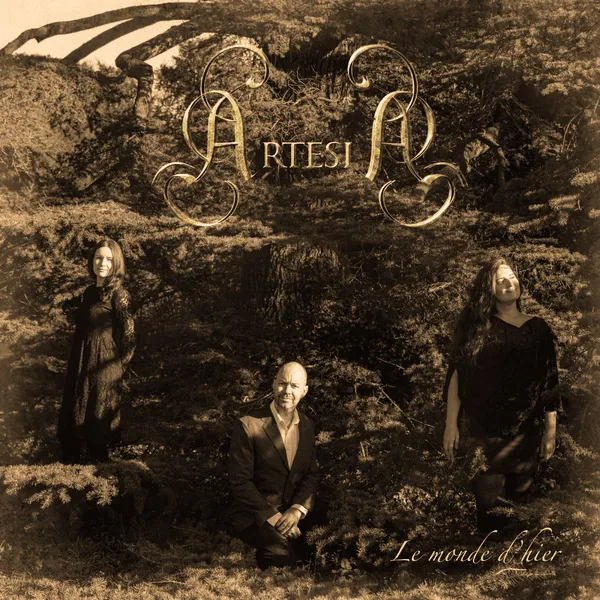
Another recent discovery has landed in my lap, as I was busy searching for some modern medieval tinged music, lo and behold, here is a neoclassical darkwave group (fine, labels are for pharmacies) from Brittany that I instantly purchased on Bandcamp within 10 seconds of listening to the track “Stabat Mater”, one of Antonio Vivaldi’s masterpieces. I am truly overjoyed of having taken the plunge, happy that my hunches always seem to workout! This is their 7th album, so there is a back catalog that needs further exploration. Currently led by founder, keyboardist and singer Agathe M., as a one -woman outfit in 2001, later adding violinist Gaelle D in 2003 and arranger Jean-Charles Wintrebert, joining in 2011.
Immediately sounding familiar, “Stabat Mater” flung my senses into a special place that rekindled memories of my youth, surrounded by parent’s classical music (until Woodstock took over, LOL) , an adventurous and intemporal flashback that oozes sagacity and responsiveness. Passion, atmosphere and melody intertwine within the short introduction, setting the stage for a journey of many splendored moments. The highly cinematic “Vastes Mers” possesses that surreal quality of the Breton-Gaelic tradition, one that owes so much to the ocean and seas, the solemnity of sailing them, often into the perils of the unknown. There is a powerful melancholic sensibility, mostly provided by a glittering violin performance (as is the case throughout the album) and supremely evocative vocals with French lyrics that are thoroughly enchanting. The companion piece “Ar Mor” maintains the magical aura, albeit in a gentler swoon, the percussives maintain point, the voices and strings doing most of the rest and so, the effusive magic finally takes hold, reminiscent of a joyful performance in a torch-lit banquet hall.
Complete change of pace with “Citadel of the Stars”, trumpets initially blaring as a veil of embalming tranquility soothes the arrangement into angelic reverie, a celestial voice leading the choir, and stellar orchestrations ensuring the maintenance of sonic pleasure in every single note played. The tone subtly turns into a darker manifestation, strings doing their thing, perhaps underlining an inevitable solitude, a glimmer of Dead Can Dance or even This Mortal Coil lingering in the mist. Six and half minutes in length, ”Foret Silencieuse” veers into the inextricable woodland where only dreams can offer the sound of silence, challenged by howling vocalizations, and a leisurely percussive pace. The arrangement is built to slowly expand and build itself into a vortex of immense symphonics, eventually progressing into an orgasmic open meadow of complete liberation.
Time to meditate with “Dies Irae”, a dim cloister of darker edges, where shadows dance with fate, a hymn to the recently departed.
The next trio of pieces could have qualified as a suite as they keep the same tension and style throughout “Vienne La Voile Qui T’emmène” , “Vallées du Nord” and “La Mort des Amants“, as it recalls the unique Breton/French tradition of folkloric storytelling , so deeply rooted in those cultures, since the dawn of time. A sense of timeless reverence, the strings escorting the procession through fog-bound forests, rain-drenched vales leading to the coast where the ocean awaits to take the soul further along. The expertly arranged music takes you elsewhere, into a mystical realm that is undeniably intense and meaningful. Symphonic sorrow never sounded better, mourning the death of two lovers, perhaps Romain and Julie, forever holding hands, holding neither grudge nor anger, choosing delicate lace and serenity to say au revoir. A gorgeous triumvirate of emotional expression.
Another shift, as “Erbarm Dich Mein O Herr Bach“ clearly espouses solidarity with some obscure kapellmeister named Johann Sebastian. Therefore, one should not be at all surprised of the overt classical bearing establishing the foundation, enticingly subtle and discreet, with orchestral detail amid the crushingly romantic violin arrangement. Yesterday’s art and yesterday’s world, played today in your mind and for your soul. Soothing.
As a final recap of all that has come before, the meditative “Receuillement” settles the score with supreme decorum, Agathe’s hushed voice amid the sonic mist provided by Gaelle’s violin, and some semblance on introspective healing is to be expected.
4 Prior realms