
I have waited 50 years to finally discover a project that would be as close to my own personal values, traditions and expertise. Lucky to have been educated by three major areas of interest that has forged my persona: multiple languages, progressive rock and history, I am overjoyed to find a familiar artist who has combined all three into one compact disc of genius. Edo Spanninga has an ongoing dazzling career with Flamborough Head and Trion, both stellar discographies that I have enjoyed and reviewed for a long time. I wish to make a few important clarifications that I hold dear. A quote often heard is that history is written by the victors. Yes, but not exclusively, as the vanquished have not lost either their fingers or their minds, and examples abound throughout the world. After all, The Greek Civilization, the Roman and Ottoman Empires, the eventual pacification of Germany and Japan into becoming vibrant democracies can only be the result of the lessons of catastrophic defeat and understanding its inherent causes. Just like most human beings, we often learn more from our mistakes than from our achievements. A real and credible historian is characterized by two major attributes , the first being the most important : study and verify BOTH sides of a conflict and secondly, to witness in person the facts or rely on one who has witnessed an event on site and who has the first attribute as well. It also helps immensely not be politically biased or worse, a paid agent of propaganda. My highest praise for Edo’s work comes from his obvious adherence to the principles espoused above. Now, onto the music and its thrilling ride, and please note that every chapter has been individually researched to the fullest in my 50 years of reading, reflection and analysis. It is neither propaganda, opinion nor fake news, just easily verifiable multi-sourced fact.
“Wannsee”: Languid mellotron ripples get overtaken by both Joseph Goebbels, as well as the Austrian corporal, the tone relatively sedate compared to the fury about to be launched on civilization. Churchill ‘fights backs on the beaches” and near a lovely lake, in a stately mansion, the upper administrative echelons of the Nazi Party met for a one-day conference to discuss and forever codify the “Final Solution of the Jewish Question”. Under the auspices of SS General Reinhard Heydrich, the fifteen high-ranking officials decided at breakfast to define the “problem”, halting briefly for lunch (sic) and then spending the afternoon organizing the genocide of an entire race on the European continent, before leaving to their respective homes before the sun had even started to set. Documented with actual audio snippets, some saying it never happened, even though Adolf Eichmann’s copious and studiously precise notes were miraculously salvaged at war’s end. World War II was the last moral war, a Nazi scourge that had to be destroyed at all costs. Debates remain over whether Hiroshima and Nagasaki were a necessary warning to humanity to stop aggression and genocidal tendencies. I have spent 55 years studying this period and wrote many an essay on the subject.
“Stettin” refers to creation of the Iron Curtain, crudely slicing Europe in half, two uncompromising solitudes ‘from Trieste in the Adriatic to Stettin on the Baltic’ (another quote from Winston Churchill). Berlin 1953, Warszaw 1956, the Hungarian Revolution from which I was spawned, The Berlin Wall 1961, Cuba 1962, Prague 1968, “Ich Bin Ein Berliner” in Berlin 1963 and JFK in Dallas (a day I remember vividly to this day). While the dreaded war was now in the past, the suffering continued as an entire continent was being rebuilt. The rolling organ sweeps into painful melancholia colliding with endless amounts of hope, the drums pushing forward renewal amid the chaos. A moving soundtrack to say the least. Documented with actual audio snippets, no one dares to say it never happened.
The synthesizer appears around the same time in the late 1960s as the space race and “Houston” recalls the incredible social leaps forward. In a remarkable twist of fate, I witnessed as a thirteen-year-old visiting my home country, Communist Hungary (from which we had escaped in 1957 with border guards shooting at a baby and its two young parents), Armstrong setting foot on the Sea of Tranquility while on summer holiday in ‘the People’s Republic’. It was a transcendental moment as the Party officials did not dare to belittle the event. Documented with actual audio snippets, though some say it never happened, even though radar, audio waves and subsequent verifications prove otherwise. MLK, RFK, Vietnam, Watergate, Woodstock and synthesizers. The arrangement flutters with excited anticipation of a new time for peace and prosperity, the flute playing the role of the pied-piper and the electronics doing the sonic adventures justice. The entire planet had, for a long moment, stars in their eyes, music in their ears and hope in their future.
Moribund and glacial sheets of icy synthesizers announce the lean economic years that announced the decline of the British Empire. And with “Port Stanley”, the Falklands conflict is beyond tragic, showcasing the human propensity for idiocy. A brutally fascist Argentinian junta led by a drunk general, using distraction to keep its people at bay, facing a British PM, reputed for having an ‘iron will’, was an unwinnable contest, as it led to the eventual demise of the military dictatorship. The music displayed is throttling like incoming Exocets and outgoing Harriers. The rhythmic onslaught is determined, resolute and unflinching. The SAS hide in the shadows; the soldiers fight for a cause; the waves continue to rule over the sheep. An instrumental soundtrack that depicts the story perfectly. Documented with actual audio snippets, though some say it never should never had happened.
“Chernobyl”. Arrogant minions playing with dangerous toys. A human catastrophe that led to the ultimate collapse of the untenable Communist dictatorship of the CPSU, and eventually forcing its leader Mikhael Gorbachev to nullify its own existence by the revelation of the secret protocols of the Ribbentrop/Molotov pact, making the Soviet Union’s annexation of the Baltic States complicit with the interests of the Third Reich! Oopsy! There is a musical interpretation of a wind of change (hello Scorpions) , though the radioactive fallout relies on solemn acoustic guitars, atomic grizzle and blaring sirens. The Wall collapses into a pile of rubble whose dust introduces a new horizon as it settles gently to the ground, the mellotrons playing a crucial role in orchestrating the new reality. The melodies are celebratory yet still marked by apprehension. Free at last. The DDR/Berlin Wall fiasco thanks to Gunther Schabowski remains proof that an ant can defeat an elephant; it takes only an instant and the course of humanity can flip on a dime. Very well documented with actual audio snippets, though all agree that the reactor incident never should have happened in the first place.
“Schengen”. A unified Europe is a great idea but who really leads it and why? Yugoslavia collapses into horror because Europe had lost its way. 9/11 becomes a new call to arms , only to be discarded as old news and new conspiracies. The track veers into all the anxious sinews of depressing piano collages, marshalling drums, collapsing bass and brassy monetary somersaults. Documented with actual audio snippets, it began as an economic union and has evolved into a political bureaucracy for the ages whose motto has become’ Its only democratic if your side wins’. The astute arrangement recognizes this complex directive with a clever Beethoven reference , asking ‘Where is the ode to Joy’?
A second major European war appears again, and the soundscape on “Mariupol” is naturally drenched in gravitas, confusion, dissonant fear, pummelling cannonades as drones flutter menacingly overhead. The Russian-Ukrainian conflict is an absolute aberration and crime, though both sides are guilty in one way or another of prolonging a senseless fraternal conflict that feeds only the war machine. Why both guilty ? Political power machinations and outside influencing has clearly played a part in the ongoing confrontation that began with the Bolshevik Revolution. Permanent resolution can only come from dialogue, as its much more complicated than tossing around one-sided opinions. Verifiable example: Crimea’s population is overwhelmingly Russian since the Tatars were mostly expulsed nearly two centuries ago, while the Donbass has a Russian minority. Should they be stripped of rights and expelled? What if Ukraine declares neutrality and becomes a non-partisan state that just minds its own business for the betterment of its own people? In between political nonsense quotes, the 12 minute + epic rambles on like all the global politicians who continue to play games with our existence, the composition flickers along with a bass line that drives all the current confusion to this day. The piano work attaches its sentiments to the gently orchestrated backdrop, sweetly shimmering in exalted indifference. We live in strange times. Oblique marimba passages and sharp drum outbreaks underscore the objective we all share , a dream to live harmoniously with one another, debating with respect, and rejecting extremes of all kinds. Documented with actual audio snippets, though all agree that it never should have happened in the first place, especially after Chernobyl disaster.
Two bonus instrumental tracks are added to the album but not within the historical/political expanse of the previous tracks, no snippets other than full on musical expression of the very highest musical calibre. “Cathedral Green” is an instrumental keyboard dominated track, an aromantic gem of contrasted progressive rock with mellotron and acoustic guitars named after the park surrounding Exeter Cathedral, UK. The song was created using only a Roland JV 880 synth module and a Roland SR-JV80-04 Vintage Synth Expansion Board. Smooth as a silk, the glorious synthesizer passages seek to evoke the need to revive our dwindling faith in mankind and perhaps take pause in what is truly meaningful in our personal and collective lives. The solemnity is breathtaking, the occasional forays into exalted passion, are meritorious. Edo does wonders on his various ivories, extirpating a wide gamut of attractive sounds, knowing full well that nothing can ever surpass a piano etude, played with reverence and desire.
On the second gift, Edo was deeply inspired by Swedish one -shot wonder Atlas and the track “På Gata” from their album Blå Vardag (1979) and adapted it into a new song. Drums were played by the legendary Italian drummer and friend Davide Guidoni (known for Daal, Nuova Era & Taproban) and crowns this tasty display of musical knowledge with a strong tine of upbeat optimism. Edo injects the church organ with impeccable boldness, a scintillating finale . Both the original and this reworking are masterclasses in style and technique, with Davide turning one of his usual dazzling performances.
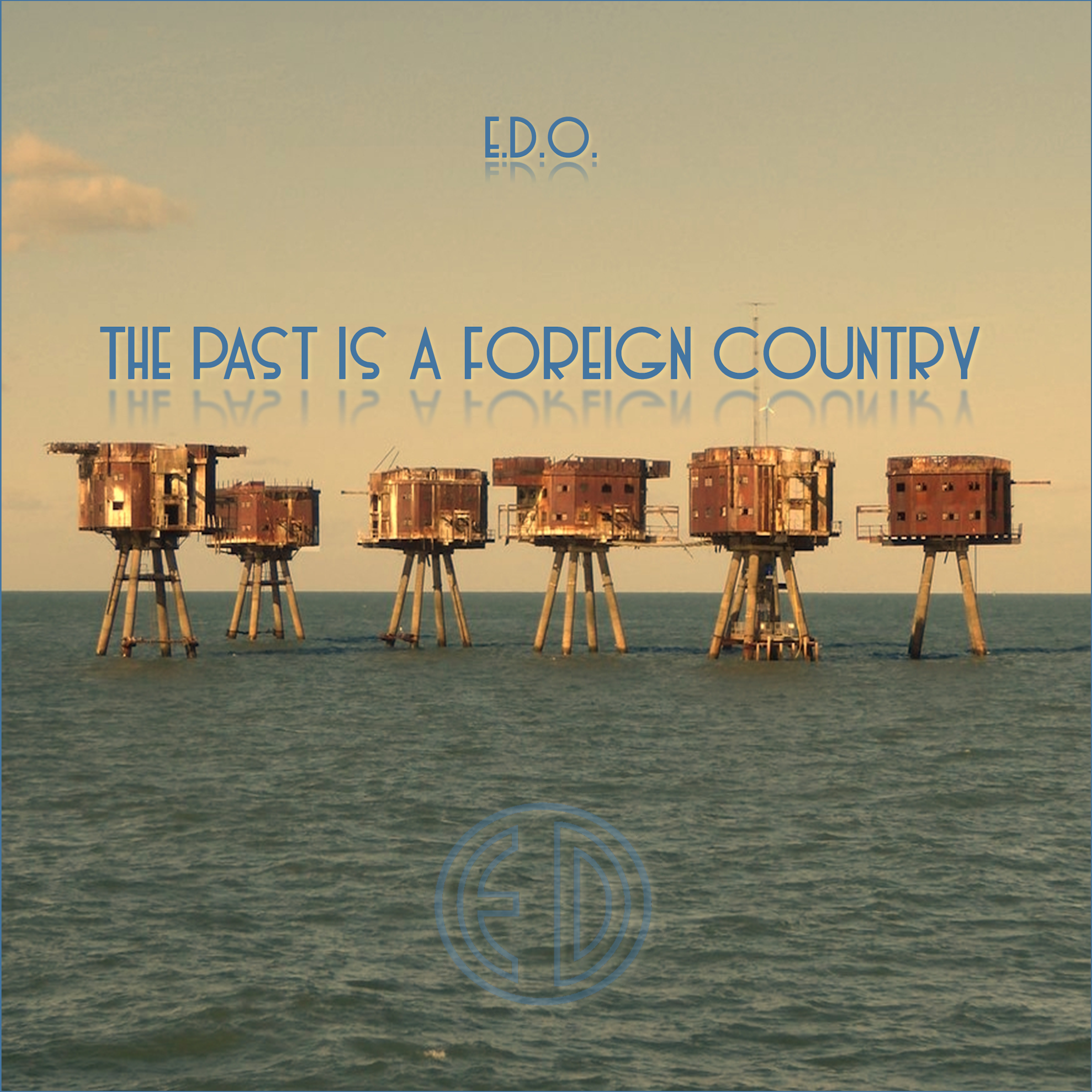
The artwork , cover and packaging provide that hallowed tradition of sitting down comfortably , headphones on and holding the physical album and its copious libretto in hand , so as to fully comprehend the story line and the parallel musical score. Because of a highly personal connection with the subject matter as well as the musician’s stellar past, this release works on all cylinders, a stunning treasure I intend to cherish until I also ultimately become history. In the very top of the 2025 vintage.
5 Historically alien lands