
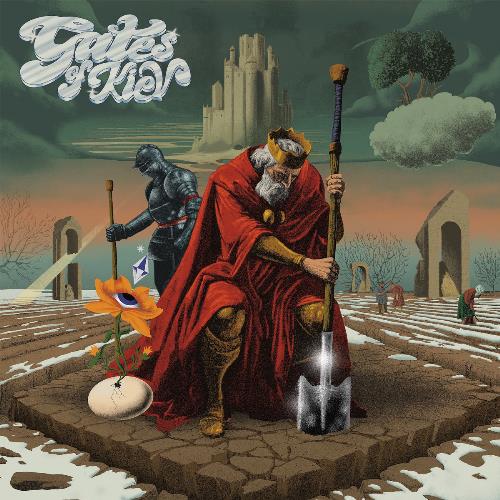
 Keyboard-centric power trio with flirtatious glances towards the obvious ELP influences as well as a dash of harder-edged rollicking in the Uriah Heep mold is to be found as Napoleon’s Grande Armée reaches the confines of Mother Russia, inspired by the Modest Mussorgsky piece. Tomas Mesman on keyboards and vocals, drummer Hessel Braat and Eszl de Vois on the bass guitar are featured in this intriguing debut release.
Why not launch a career with a bold epic that covers nearly 13 minutes on “Hamlet Burns“ ? Layers of wind-blown effects and distant violin traces induce a sense of unease, when suddenly, out of the dark clouds a lone Hammond organ roars forth, thundering drum in complete agreement and a gruesome bass undertow that sweeps the road towards Siberia. The fiendish vocals are angered by the stormy disposition of a rampaging wall of staccato keyboards, with organs, synths and mellotrons doing most of the savage damage. Hessel demolishes his kit with a Keith Moon-like brutality that will shock a few into disbelief. Eszl licking the wounds of the endless enigma displayed, the sure-handed turbulence is quite remarkable. Shakespeare is surely trembling in his celestial underpants. Tomas even dares a head-bobbing Thijs van Leer organ hocus-pocus showcase.
Two filling pieces in the 6–7-minute range provided the cream in the Oreo cookie, first of all on the initially sedate “Baltazar’s Feast“, which then explodes into a Ken Hensley rock n roller that leaves a lingering aftertaste of ‘Demons and Wizards’ in its wake. The hustling bass shovels the bustling drum attack along the wide ivory canal provided by Mesman, a magnificent exhibit of domineering keyboard production. The shift to a more sympho-prog is noticeable on the silken “Silhouette“, with a more grandiose predilection for overarching passages that characterizes the pieces and perhaps even the title. The conquering trio cannot sustain the restraint for too long and halfway through, they revert back to the pugnacious assault that they seem to favour, high and mighty.
And sandwich the whole with another similarly sized epic finale on “Drunkship of the Mice”, a similarly constructed arrangement as the opener, a slow burner with a reflective, almost meditative languor that you simply know is going to eventually explode unashamedly between the ears (yes but when?) . Four minutes in, the Middle Eastern theme picks up steam like a midnight train to Marrakech, increasing in both velocity and depth, unexpectedly switching into a temporary, almost carnival-like soundtrack. Our Dutch orange jugglers like to keep one close to the edge and its not the churning organ that adjust the tone but an extended and forlorn piano etude that twinkles like the night sky, before deliberately rising into a calm vortex of sound, entirely fuelled by the thundering drum exhibition, a stunning exercise in contrast. When the end becomes apparent, the thrashing becomes a volatile wall of percussive hammering that no siege can penetrate. Fierce.
4 Eastern entrances