
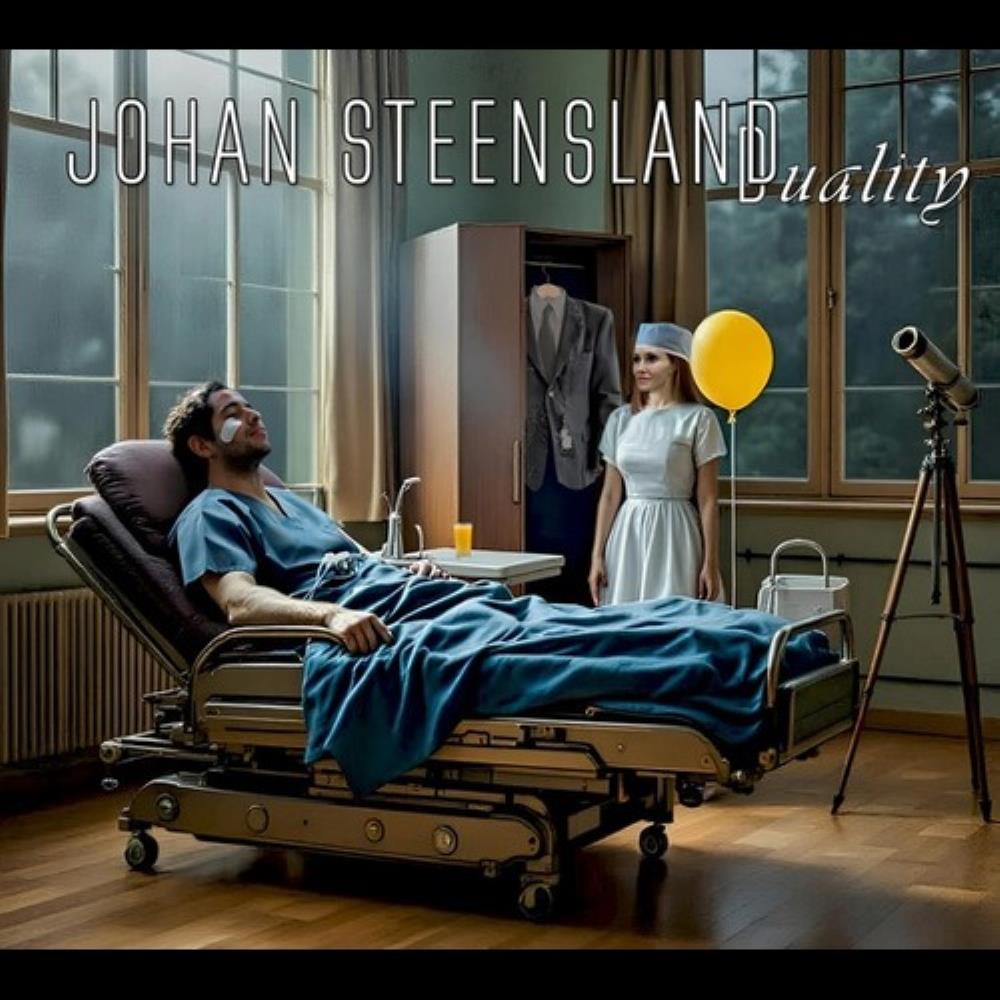
Johan Steensland is a Swedish composer, teacher, multi-instrumentalist and vocalist, who has expanded his craft to include progressive pop and soul-fusion, though here he proposes an outright progressive 63-minute rock-opera. This will be my first dive into his musical world, so I enter without any preconceived notions or historical background, a challenge I happen to enjoy a great deal. Duality is about a fiction writer (Eddie) who suffers from amnesia, and Lydia, the head nurse at the hospital where Eddie wakes up, as expertly depicted on the album cover. Let the curtain be raised and enjoy the show. He is helped along by some known guests namely vocalist Aleena Gibson as well as guitarist Per Nilsson both well-known for their work with Kaipa.
“Fragments” is a classic overture, getting the juices flowing with an appropriate amount of melodic impression, a gentle serenade that picks up steam as the rhythm section, guitars and assorted keyboards launch into a temporary storm of bombast and pomp, before quickly recoiling into calmer realms. Like all worthy classical operas, it behooves the audience to invest time, money and effort in getting the libretto to fully delve into the subject matter, hence the physical album may be of great help. Perhaps influenced by Pink Floyd’s “the Great Gig in the Sky” about all the various stages of impending death, including circumstances and consequences, the storyline evokes all the psychological urgency of amnesia, pain, delirium, fear and anger.
Steensland can croon with the best of them, yet also capable of belting out whirlwind pleas seemingly at will; he is truly a very gifted singer. I should also be pointed out that there is a theatrical Marillion/Genesis sense to the both the voices and the instrumental backdrop, with a clever dosage of orchestrations to boot, blurring that line between neo and symphonic prog . Aleena sings the role of Lydia with a nurse like confidence and empathy, hitting the high notes with impunity while Johan handles the Eddie part, a scrambled mind and tortured soul searching for any straw to clutch (Hello Fish!). Per Nilsson delivers much-needed metallic electricity with surgically placed axe (scalpel?) interventions that only add depth to the instrumental palette, particularly on the hyper “The Shredded Suit”.
There are enough well positioned roller coasters moments to eliminate any hint of overplay or boredom, maintaining the attention at all times. But all operas are much better in a live setting anyway, with real characters expressing themselves for all to see, admire and applaud. Concentrating on the flow with earphones will also work, eyes closed so that each listener can create their own images, but casual background music cannot deliver the goods. On the exalted “An Ordinary Man”, the jazzy drum shuffle is utterly surprising, the cabaret like singing supremely valiant, and the arrangement almost old school as if listening to a film-noir arrangement. Nilsson peels off another wild vortex on his frazzled six strings, insistent, voracious and extra-ordinary, perfectly encompassing the confusion of a troubled mind.
Judiciously variable while inserting piano, flute and Lydia’s pleading advice, Eddie opens the door to “Let Me In! “, as if some escape hatch would beckon on the horizon, real or imagined, one can never know for sure. A terrific duet, as the two protagonists whip up quite the storm of emotions, both singers hitting their respective high notes with incredible technique. Teetering on the brink is the theme on “Walking in a Straight Line “, a piece suitably disheveling and rhythmically jagged, laden with gigantic dynamics, as if some internal battle requires constant pause to save energy for the next hill to climb. The second half has some severe schizoid moments, buoyed by hushed refrains, corkscrew guitar injections, and palpable anxiety. A serpentine fretless bass (Owe Eriksson) swerves on the liquid “Black Sea”, Aleena alone in the spotlight, piano in tow, as John responds to her questions, with crushing anguish. An excellent trio of songs that really hit the spot.
Oblique pulses illuminate “The Dr. Dorian Dance”, an underlying choir mellotron providing the opera-ting table for some clinical discourse, surrounded by clanging guitars, dripping anesthetics, overtly bright luminosity hiding behind the doctored white cloak, and a Nilsson drill guitar solo that spares no oxygen. Recovery time will be necessary, and that is what one gets to hear on “What Would You Give?”, a more straightforward tempo, and Aleena verging on torch singing , with Johan responding with begging desperation, the instrumental medical staff keeping things hygienically sterile while the mercurial guitar spirals onwards.
The 10 minute and 8 second “Here and Now” is the appropriate grand finale, a finely sculpted epilogue by a fairy-tale flute (Ture Trygger is the pied-piper), as well as highly theatrical setting, the stunning vocal duo combine to meander into each and every sonic crevice that teems with life, constantly pushing the envelopes of yesterday and tomorrow, as the present is relative. The piano plays the role of rudder, steering firmly into the final outcome, rekindling impressions of cinematic musical dramas that have flourished since the dawn of movies. An exemplary climax brings the velvet curtain down on a thoroughly entertaining opus, that I enjoyed way more than expected.
Thanks again to Anne-Claire of Bad Dog Promotions for introducing this impressive artist.
4 contrasts