
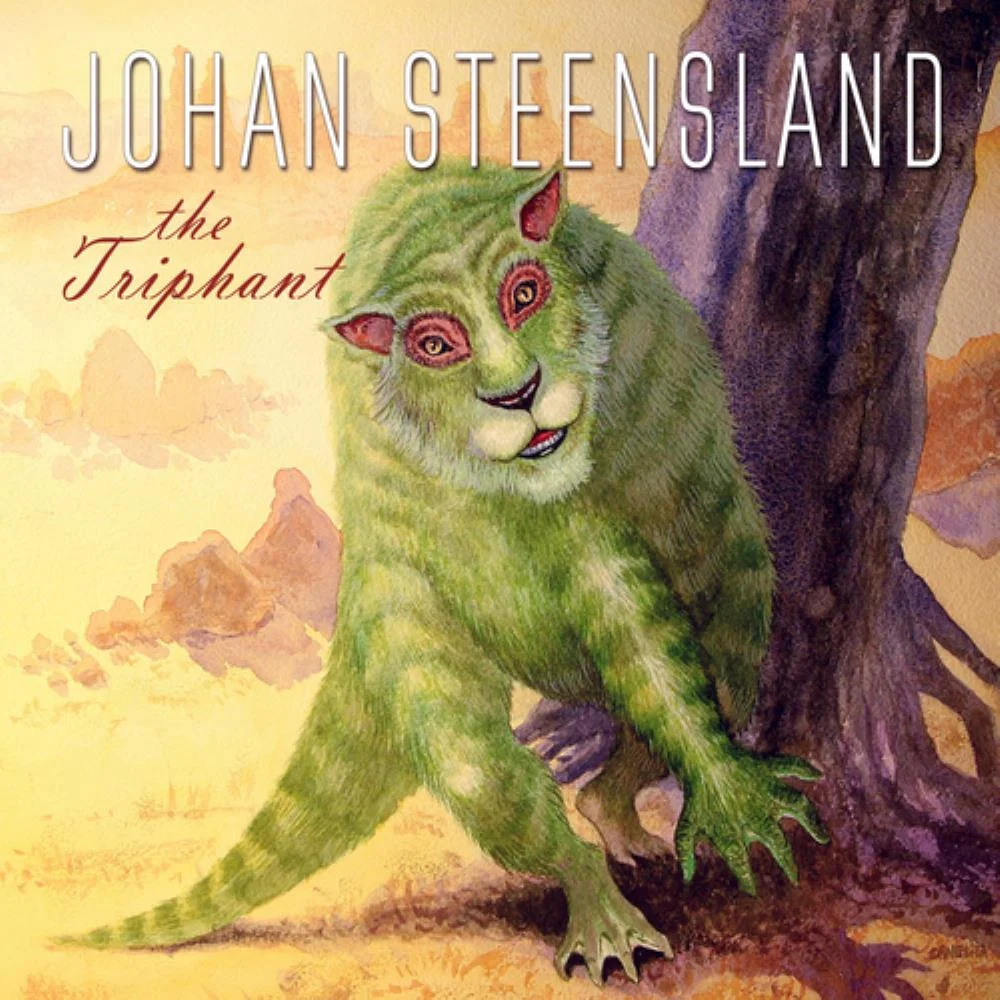
This Swedish talent really caught the prog world by surprise with last year’s acclaimed “Duality” rock opera album, which I happily reviewed, lo and behold, here comes another colossal third effort, with a few more stylistics twists to keep us pundits off balance. Proggers love vertigo LOL! I must hunt down the debut Crossfade, if this continues …The premise is a strange encounter between two potential extremes, a computer scientist (all cartesian and sterilized) and a painter (where colour, texture and feeling flourish), staying close to the previous duality concept. Johan once again handles pretty much all the instruments and vocals, save for the drum kit taken over by Jonathan Lundberg, fretless bass from Owe Eriksson, Ingemar Brandt on piano, Emily Francis on keyboard soloing, and flute/oboe from Ture Trygger.
The eleven tracks span a spectrum of bold surfaces, starting off with a kaleidoscope of shorter snippets, an orchestral “Intro” , segued by a whimsical “The Parade of Dancing Toddlers” with its carousel, circus-like feel. The circular sonics create quite the hypnosis, like the bobbing horses going round and round, with smiles and laughter erupting. Switching to bumper car rhythms, “Stroke by Stroke” is rather chaotic whilst still structured in a lean, almost binary pattern, where Johan gets to emote with unleashed abandon. The crunchy guitars, burly bass undertow, and the relentless beat keeps the Ferris wheel-effect spinning.
Piano comes to the fore on “The Lab Rat’s Escape” , an eerie tensioned piece in an anti-septic setting, Johan expanding on the inner turmoil of wanting to be free as the wind, the fretless bass underlining the weeping agony of despair, the piano offering some semblance of hope, ‘dreaming of change’. Sticking to the subject matter, “Save Me from My Dreams” cries out with incredible passion, Johan singing in a sobbing tone that may recall Andy Latimer in his prime. A conflicting realm of doubt and fear, unsure of step, scared of taking any risks and the worry of failure. Worst of all, surrender may be the only option left.
A denser epic , flirting with the 8-minute mark, the drama increases into a sweeping roller coaster ride of sensibilities , “Nothing Wrong” coming across as a real tour de force with crisp guitar interventions, like sizzling shafts of light in a confused darkness. The dual tensions are palpable, even with the softer atmospherics that touch the outer borders of the lunar dark side. “It’s not a world; it’s a fantasy and a lie “ pretty much like the state of the world today…
The shrouding obscurity of a muted charade on “Give it to Me” summons a brutal tendency, littered with plenty of haunting sonics, a cascade of whirling organ and choir mellotron to heighten the urge. The raspy guitars and anger-laden lyrics beg for some finality. While at the other end of the spectrum, the ambient beauty of “The Sitting “recalls some sombre lullaby, with minimalist color fields and monochromes, a still form, unable and unwilling to move in the slightest. A frozen impression of apparent calm. The computer scientist and the painter.
Kicking off like an artillery barrage , “Lay Down Your Guns” veers eventually into a ‘drole de guerre’ jazz no man’s land with guardian synths patrolling the skies. It’s urgent, coarse, unflinching and ultimately, utterly desperate as its fades into silence. “The Calling” has a neo-ballad feel, a gentle caress of voice and music, a tapping beat keeping time. It’s a romantic love song, you know, a prog specialty….cough! The sensual slip of a fluid guitar, a surging organ hand in hand with an increasingly overcome voice, oohs and aahs in the backroom. This track made me smile in uncertain ways.
‘A steppingstone to a higher ground’, “Layers of Skin” is the final track and lengthiest by a few seconds only. The two bodies touch, both minds connect but will they ever become one, can it even be possible ? This dualism is consecrated, musically, lyrically and vocally with an overarching painful vocal display, matched by a stirring guitar solo, very immersed in the Camel pantheon (IMHO), with a more experimental sheen and chock full of contrasts , which is theme of this album as well as the style preferred by Mister Steensland in his career up to now. “The Triphant” is a triumphant page that deserves attention, interest and even adulation. The finale is simply amazing.
4.5 Cornelian tragedies