
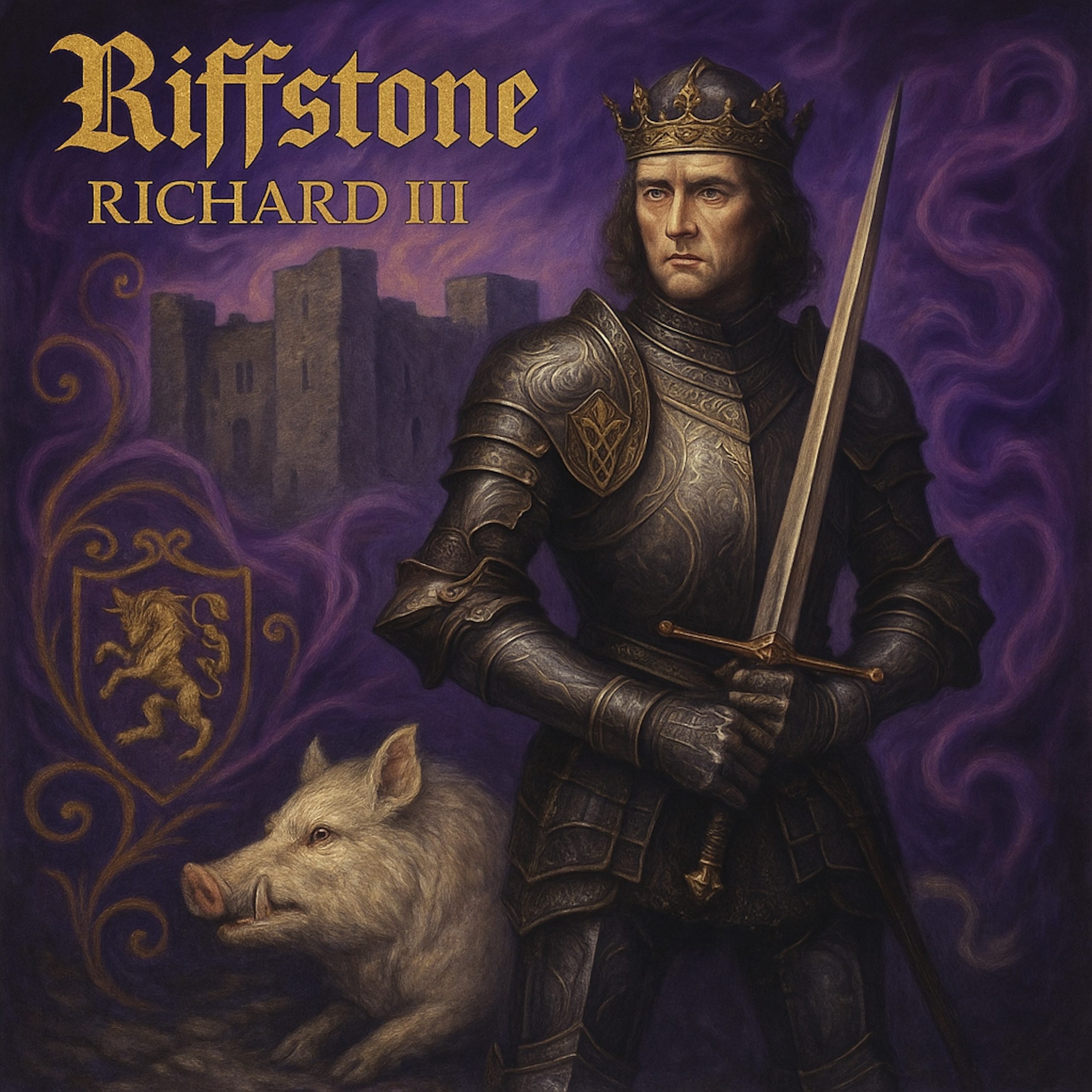
How delirious can a reviewer be when two of his favorite multi-instrumentalist one-man band artists get together for a new project? And how ecstatic can he then become when it’s another historical take that happens to be a lifelong passion of this said reviewer? Two birds with one stone , add a few riffs and you get RIFFSTONE! In the blue corner, wearing the red trunks , out of Wirral in the UK, the amazing man behind Spirergy, with 2 world class albums, mister …Dave Allen… (wild applause). In the red corner, wearing the shiny blue trunks, from Salford, UK, the one and only (pun fully intended) musician behind A Multitude of One, and a busy 2025 renaissance man, the prolific … Colin Powell… (insane clapping). The union came about when Dave had an uncontrollable urge to revisit a long-buried project dealing with a controversial (according to Shakespeare) figure in English history, Richard III. Dave recently enjoyed the stellar Powell achievement with the “A Templar’s Tale” saga, both in terms of music and the colorful 44-page booklet, he reached out to his fellow ‘boxer’ and suggested a bout or two in the ring. Colin wasted zero time in agreeing to the billing. And the rest is history, in all facets of the meaning of the word!
This is a historical extravaganza that will require the fascinated listener to do a little research, either via the web or even better yet, via something called ‘books’, to fully immerse themselves in the story. A complex character which would be the case for every single famous figure throughout time, from Moses to Gandhi, Caesar to Louis XIV or Mussolini to Stalin, or even Ghadaffy or Putin, real history is when massive research is required to verify the positives and negatives of each individual, understanding both allied and enemy viewpoints and discarding opinion-based propaganda (the current and pervasive scourge of mediatic humanity). One fact is certain, Richard III’s death at the battle of Bosworth Field on August 22, 1485, marked the end of both the Plantagenet dynasty as well as the final gasps of the Middle Ages.
Eighty minutes of music will serve as a soundtrack for this epic tale, combining modern musical technique with the spirit of that age, when kings and castles ruled the realm, with endless intrigue, treachery and tragedy, but where valor, courage and defiance also held sway. As we arrive at the moat, “Richard’s Tale” lowers ceremoniously the iron-gated drawbridge, gaining entrance into the fortress of time and space, narration guiding the torch-lit procession into the inner courtyard. Powell and Allen liberally decorate the sonics with symphonic underpinnings ,as the story unfolds. “October 1452” joyfully announces the future King’s birth, describing his background, upbringing and education, as a privileged lord in a playful and breezy arrangement that illuminates a sense of innocent grandeur.
Now that the main character has been introduced, the dive into the regency begins in earnest. “Plantagenets” is mostly dominated by intense organ passages that inject a dash of gravitas, as looming conflict with jealous Lancastrian rivals , the programmed percussion militaristic in its organized chaos propulsion, balanced by some slippery synthesizer runs as well as sharp guitar phrasings. Blaring trumpets announce “House of York”, and this is where the fog of war begins, a thirty-year conflict that will end in tragedy for one and victory for the other. The glistening lead guitar adorns this vocally intense piece, laden with stupendous choir mellotron ridges and weighty bass ruffles, a definite highlight moment in the classic British prog style.
“Fotheringhay Castle” is where Richard was born , and the pastoral acoustics are astoundingly typical of the folk tradition, a crushingly beautiful melody, paralleled by an omnipresent operatic voice. It comes across like a traditional piece before evolving into more muscular bass-led interventions, and the blooming composition takes on its full splendorous shape. As ‘sing for me’ is repeated, choir in tow, I kneel at the altar. A masterpiece. A pastoral piano and narration (Colin taking care of that duty throughout the release) introduces the stately “Middleham”, as both Colin and Dave share the microphone, a sweet tale that evokes all the majesty of the British countryside, with a spirited saxophone adding to the redolence. It has an almost vintage Yes-like feel, in terms of the dreamy vocalizations, ‘full of wonder’, and certainly can only add jubilation to the awakening choir. Ornate guitar completes the imagery to perfection.
Threateningly distant mellotrons usurp the intro on “War of the Roses”, spoken word eulogy to the fallen, as the battlefield sounds come in like an unremitting artillery barrage of crashing cymbals and thunderous beats , as the Lancastrian red and York white collide in mortal combat, ‘the crown between two thorns’. Expertly sung with passionate conviction by Dave, the guitar duels emulate the bloody hand to hand struggle, the attacks, feints and parries all there to behold.
Anne Neville is presented and an extended instrumental tribute , where both Dave and Colin get to stretch out their prowess , keyboards taking centerstage, soon to be joined by some spirited electric playing , giving both Gibson and Fender a stage to extol their reputations even further. The background acoustic guitar work is phenomenal; I am sure Ant is smiling somewhere in cricket land.
“Lord Protector” has Colin espousing the duties of the king, an oath to defend the people from usurpation, invasion and civil war. The churning guitars fling the arrangement into immediate overdrive, where grumbly bass, slithering synths, and splashy thuds set the course for some Steve Howe-inspired mayhem, an extraordinary delight.
The title track continues the constantly excellence of the narrative, serving to condense the entire saga into one culminating musical essay. It has therefore a grave and solemn expansion, drenched in a sense of sorrow, of history not willing to elevate the complex character to a balanced conclusion. As an amateur historian, there are very few ‘pure’ and entirely virtuous characters in human history, all having a dark side of some kind, wrapped in either mystery or jealousy, often both.
“The Princes in the Tower” explains how succession can be a tricky and often obscene affair, as powerful monarchs, dictators, modest politicians and even athletes are unable to have their offspring succeed or even surpass their progenitors. History of all peoples have similar instances of failure to ‘keep it in the family’. Much like with Napoleon II (‘L’aiglon’), no son or daughter can expect to get a free pass. Edward and Richard had the tower gaol garnished with ill-fated children who were destined to disappear forever.
There is a legendary quote that has transcended both time and space, ‘A horse, a horse, my kingdom for a horse” and William Shakespeare wasted little time or effort in stamping Richard II with a villainous depiction. “Bosworth-Last Stand of the White Boar” recounts the final battle, as the victor Henry Tudor becomes the founder of a new regal dynasty in the land, a major turning point in British history. The arrangement has all the neighing pace and galloping spittle
“Eulogy” says it all, the mythical King of mystery has passed, dying on the battlefield, his blood permeating the soil. Like so many other historical figures, one cannot jump to premature conclusions , certainly not based on cheap opinion peddling, taking sides as if some 21st century political battle, and actually believing that all monarchs were evil and all current ‘elected’ officials.
The drop dead gorgeous “Here Lies the King”, behaves as a posthumous hymn-like tribute to a once misunderstood ruler of an often-troublesome land, with a rather taciturn people, and a rich chronicle of both glorious and less appealing chapters, going back to the time when druids advised at Stonehenge. The music is appropriately respectful, grandiose and will surely direct some listeners to investigate further this tragic figure. I certainly did, and was completely enthralled by what I discovered.
This is an adventurous 86-minute album, worthy of any musical collection, and needs to be listened to as an entire experience. Unfortunately , I am so loyally in love with Spirargy’s “Aeon” and “Journey Beyond” as well as “Templar’s Tale” and “Book of Enoch”, that I cannot foresee the possibility of divorcing and eloping with Richard III, yet! But like Bela Bartok once famously stated, “Competitions are for horses”. I love them all, equally.
4 English monarchs