
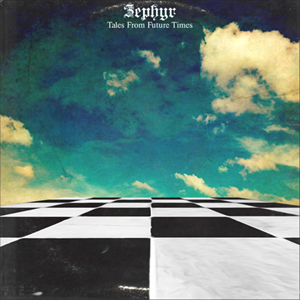
Out the wild blue yonder comes another one-man prodigy, Wiley Stillwell is not a genetic laboratory blend of some loony toon coyote and a former legendary US army general but a bona fide whirlwind multi-instrumentalist of the highest order. Under the appropriate moniker Zephyr, his mastery of instruments is astounding . Equally adept on electric and acoustic guitar, bass, drums, and a rather extensive array of keyboards (Minimoog Model D, Nord Electro 6, Novation Summit), referencing the very early psychedelic classics of the late 60s up to revisiting all the glorious wanderers that followed right behind, Wiley distills a heady brew that spans time, history and space, forging his own little personal universe. Boy oh boy, was I in for a surprise and so will you, of that I am sure, your honour!
Everything exudes a distinctive retro-feel, from the voluntarily shaded 1972 cover art and having the audacity to create the ultimate progressive rock sandwich, a massive opening slice, the 21 and such minute, eight part suite “ The Reflections in a Shattered Prism”, followed by a filling 7 and a half minute “Memoirs of the Future” and finishing off with another 11 and a half minute finale ”Solaris” with its 7 sections . There is an undeniable reverence to the pioneers of keyboard prog , namely the usual dynamic duo of Emerson and Wakeman, as well as hefty winks at such illustrious masters as Rick van der Linden, Kerry Minnear, Flavio Premoli, Jurgen Fritz, Eddie Jobson, Dave Stewart and Thijs van Leer, among many others.
The exhilarating opener is not just an ivory arsenal display meant to impress, even in the quietest moments but truly a much wider diversity at play, with subtle interference of acoustic and electric guitars when warranted, as well as solid bass punctuation throughout, the shuffling drums reinforcing the tempo. The contrasts are omnipresent and constantly favour surprise over redundancy, one never has the impression that this was a cut and paste editing job, as the sonic design is focused on flow as opposed to geometry. There is an overt playfulness that accentuates the joy of playing somewhat complex music. The unexpected Jon Lord organ finale recalls some iconic Swiss aquatic fumigation (wink).
The middle filling is loaded with a voluminous variety of tasty toppings, a spacy cosmic sauce adding spice (think instrumental Nektar, Wallenstein or Eloy), thankfully very retro and packaged with natural production (sorry, AI). The elongated and persistent organ section is a gripping mix of Booker T, Gregg Rollie and Brian Auger, and seals the deal already, as this is worth the price of admission, hands (and fingers) down! The psychedelic electric guitar segue is plum pudding perfect. The organ hurricane returns momentarily , long enough for a bopping bass solo and a cat scratch fever axe grind. The title expresses flawlessly the music presented.
With a title like “Solaris”, you can bet your hippie trippy bippy that the imminent thrust into the outer cosmos is only dependant on the engines being on and Major Tom fastening his helmet, while the countdown finalizes the launch. Here the planets collide, the black holes appear before the ‘all quiet’ signal is given. Once finally in orbit and beyond the pull of Earth ‘s human stupidity (as Einstein once claimed), the mellotron shuttles the guitar along in floating harmony with the universe, a slight hint of Gong amid the star-lined horizon. The reversed effect is one of galactic isolation, liberated from routine and ennui, leaving behind the daily grind, the mediatic governance of lies, the distractions of false technology and the whirlwind effect of stultifying monotony.
Rarely does one get to applaud a successful initial release, having no history to base one’s opinions on. Just pure unadulterated fun. Beep beep!
4 warm winds